
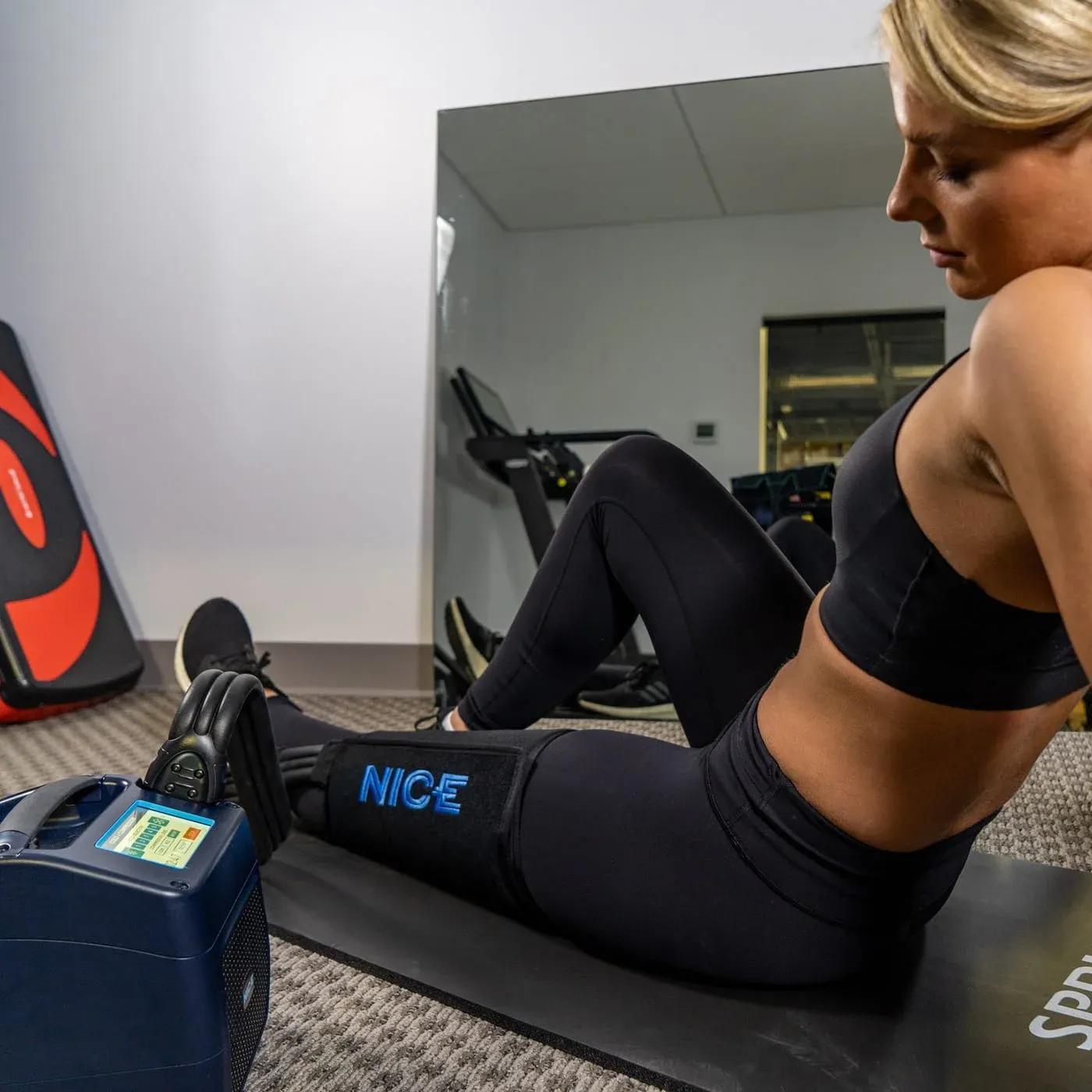
Search “cold therapy machine” and you’ll find plenty of marketing and not much of what actually got published. So we went looking at the clinical literature, the systematic reviews and meta-analyses that pool multiple trials, to see what’s actually been studied and what it found.
Short version: cold therapy as a category has real evidence behind it. Whether a machine specifically outperforms a bag of ice is a much shakier claim than the industry usually makes it sound.
What the reviews actually found
A 2024 meta-analysis pooling 31 randomized controlled trials on cryotherapy after total knee arthroplasty found that cryotherapy in general, compared to no cryotherapy, lowered pain scores in the first few days, reduced opioid use, and was associated with less blood loss. But when the same review compared continuous cold-flow devices specifically against simple cold packs, it found no meaningful difference in pain, opioid use, range of motion, or knee swelling.
A separate 2023 systematic review of 8 randomized trials, focused specifically on swelling after knee replacement, found no significant difference between device-based cooling and manual ice packs in most of the included studies.
It isn’t universal. A smaller prospective study (Acta Orthopaedica) did find a significant difference favoring a cooling device over manual cooling, in knee swelling on day one and in range of motion at several later points. One earlier review of knee replacement trials found opioid use was significantly lower with cryotherapy in the first week, and noted that device-based cooling appeared to strengthen that effect compared to ice packs, while finding no consistent benefit to swelling or motion at any time point.
For ACL reconstruction, the picture is similarly split. A 2025 review of 9 trials covering over 500 patients described the evidence as inconsistent, citing wide variation in protocols and follow-up periods. An earlier, smaller ACL meta-analysis did find a significant reduction in pain scores at 48 hours with cold compression devices compared to no cryotherapy at all.
Why reviewers keep saying “more research needed”
It isn’t a dodge, it’s accurate. Trials in this space vary in almost every dimension that would let you compare them cleanly: session length (ten minutes versus 48 hours continuous), timing relative to surgery, which outcome gets measured first, and how swelling or pain actually gets scored. Pool studies that different and the honest conclusion is “mixed,” not “doesn’t work.”
What this means in plain terms
Cryotherapy broadly, as a category, has decent evidence behind it for pain and opioid use in the days right after surgery. That part holds up across multiple independent reviews.
Whether a powered device beats a cold pack is a weaker claim. Most of the higher-quality reviews found comparable outcomes between the two. A few individual studies favored the device; most didn’t find a statistically significant edge.
Where a machine’s case gets stronger is somewhere the trials don’t really measure: does the plan your surgeon wrote down actually happen every time, at the temperature intended, without someone managing a cooler at 2 a.m.? A device that holds a set temperature removes that failure point. That’s a real, practical difference, just not the same thing as a device being clinically proven superior to ice.
If you’re weighing a cold therapy machine for your own recovery, it’s worth asking your surgeon or physio what they’ve actually seen work for your specific procedure, that clinical judgment is more tailored than any review pooling hundreds of different patients. If you’d rather skip the logistics of managing ice altogether, the rental page explains how that works in practice.
Sources referenced above: Cryotherapy for Rehabilitation After Total Knee Arthroplasty: A Systematic Review and Meta-Analysis (2024), Effectiveness and Methods of Cryotherapy in Reducing Swelling After Total Knee Arthroplasty (2023)